
Please check the average dates of last frost for your area before choosing your ship weeks.
Search
Eutrochium fistulosum 'JoJo' 'JoJo' Joe-Pye weed
'JoJo' Joe-Pye weed
As low as:
$192.65 per 32-count deep plugs, full flat (32 plugs) - $6.02 each.
Other sizes may also be available.
Characteristics
Descriptions
Alternative Scientific Name
Eupatorium fistulosum 'JoJo'
Light Requirements
sun, part-sun
Soil Moisture
moist, wet
Soil Description
rich, average, loam, clay, sand, gravel/rock
Height
3'-4'
Recommended Spacing
2'
Bloom Time
July, August
Bloom Color
pink
Hardiness Zone
4, 5, 6, 7, 8
Description
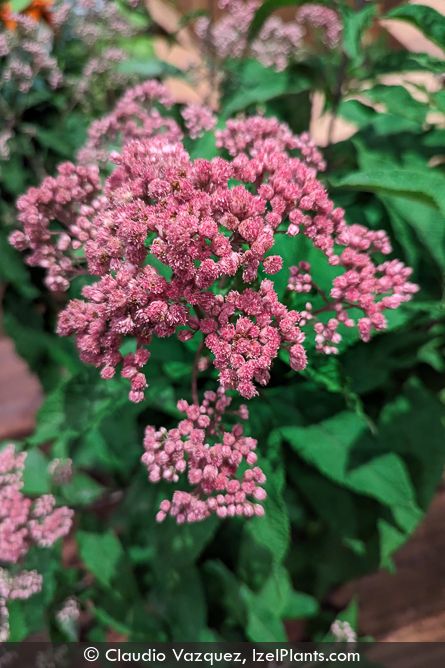
If you love the look of the impressively large Eutrochium fistulosum but don't have the space, here's a small-scale alternative with punched-up flower glamour. Eutrochium fistulosum 'JoJo' (PP34665) is a beautiful, compact cultivar of hollow Joe-Pye weed. 'JoJo' tops out at 4 feet—considerably shorter than its 7-foot parent. This cultivar differs from the species, and other existing cultivars, in having vibrant pink, double flowers that bloom freely for 4-6 weeks in late summer, creating one of the showiest floral displays within the genus. The stems are dark maroon at maturity and resemble those of the better-known cultivar ‘Little Joe’. This selection was discovered by our friends at Kind Earth Growers in Ottsville, Pennsylvania, as a chance seedling among a block of Eutrochium fistulosum. Its shorter, more compact stature and upright habit are a great fit for managed landscapes. Combined with a longer, brighter, showier flower display, ‘JoJo’ is a visual knockout in the garden.
Cultivation
Like the species, 'JoJo' performs best in consistently moist, rich soils and full sun. It's adaptable to a range of soil types and will grow in average garden conditions but doesn't tolerate drought. Too much shade will reduce flowering.
Recommended Spacing
Space plants 2' on center.
Eutrochium fistulosum 'JoJo' is more compact than the species, but will still get to 3' in width. Planting 2' on center will make for dense coverage. Plant further apart to have individual plants stand out.
Companion Plants
Combine 'JoJo' with plants that support wildlife and that appreciate wet or moist conditions. Consider Chelone (turtlehead), Liatris spicata (dense blazing star), Physostegia virginiana (obedient plant), Symphyotrichum novae-angliae (New England aster), and Solidago rugosa (wrinkleleaf goldenrod). Add in graminoids such as Juncus effusus (soft rush), Carex amphibola (eastern narrowleaf sedge), Carex grayi (Gray's sedge), Carex crinita (fringed sedge), Deschampsia cespitosa (tufted hairgrass) and Panicum virgatum (switchgrass).
Additional Notes
The tradeoff for the showy display on 'JoJo' is that double flowers lack pollen, and thus lack seed and direct support for pollinators. So, it's kinda like having a roadside billboard letting you know where the diner is! Plant it among keystone species like Solidago, Symphyotrichum, and Rudbeckia that can serve the pollinators while you enjoy the charms 'JoJo' provides. Protected under PP#34665.

Pricing & Availability
Advance orders for spring
BUY MORE,
SAVE MORE
$25 off orders of $500 or more
$100 off orders of $1,000 or more
$200 off orders of $2,000 or more
15% off orders of $3,000 or more
Orders placed now can ship as early as the week of April 5th.
When you add plants to your cart, you will be prompted to select your preferred ship week for each item you add to your shopping cart.
You may choose to have your plants shipped later than the first available ship week, and you may also choose to stagger the shipments to meet your planting schedule.
Note on spring shipping: Early spring shipments might include plants that have not yet broken dormancy, or have not been vernalized and will be frost-tender.
Please use your best judgment when selecting your preferred ship week: When you add plants to your cart, a link to the average dates of last frost will be included in the pop-up.
Did you know? When plants are available from multiple growers, we list growers closest to your location first.
Choosing the growers closest to you makes it more likely the plants are consistent with your ecoregion, and lowers the shipping carbon footprint.
Advance orders for fall
BUY MORE,
SAVE MORE
$25 off orders of $500 or more
$100 off orders of $1,000 or more
$200 off orders of $2,000 or more
15% off orders of $3,000 or more
Orders placed now can ship as early as the week of August 17th.
When you add plants to your cart, you will be prompted to select your preferred ship week for each item you add to your shopping cart. You can elect to stagger your shipments to meet your planting schedule.
Note on fall shipping: Plants that ship late summer through fall may have been cut back prior to shipping. This does not affect the health or viability of the plants.
Please use your best judgment when selecting your preferred ship week.
Did you know? When plants are available from multiple growers, we list growers closest to your location first.
Why choose plants from the nearest grower? Choosing a the grower closest to you makes it more likely the plants are consistent with your ecoregion and better adapted to your location. In addition, shipping plants shorter distances typically uses fewer resources, something we can all get behind!
BUY MORE,
SAVE MORE
$25 off orders of $500 or more
$100 off orders of $1,000 or more
$200 off orders of $2,000 or more
15% off orders of $3,000 or more
Orders placed now can ship as early as the week of April 6th.
When you add plants to your cart, you will be prompted to select your preferred ship week for each item you add to your shopping cart. You can elect to stagger your shipments to meet your planting schedule. Would you like your plants shipped later? You may choose to do so in the shopping cart.
Would you like your plants shipped earlier? Please check with us BEFORE placing your order so that we can verify that your requirements can be met.
Note on spring shipping: Early spring shipments might include plants that have not yet broken dormancy, or have not been vernalized and will be frost-tender.
Please use your best judgment when selecting your preferred ship week.
Did you know? When plants are available from multiple growers, we list growers closest to your location first.
Why choose plants from the nearest grower? Choosing a the grower closest to you makes it more likely the plants are consistent with your ecoregion and better adapted to your location. In addition, shipping plants shorter distances typically uses fewer resources, something we can all get behind!
Plant Sizes
Sizes Sizes
Sizes info
Shipping & Planting
PLANTING INFO:
Planting plugs:
We consider plugs ready to ship when the plants’ roots have filled the entire liner cell and the plants can easily be pulled out. In some cases you will have to go about it gently, wiggling the plant by the crown, and possibly squeezing the bottom of the liner to compress the growing medium and release the roots. Other times, the plants will appear to be root bound. They are not in the traditional sense. The plants are healthy but they have used up all the growing medium available to them. Plugs are at an aggressive stage of growth. As soon as planted the roots will immediately expand into your native soil. They establish faster than plants in larger containers, because they don’t have the luxury of a lot of growing media that can inhibit the roots from venturing outside of their comfort zone.
We are not going to address area preparation because the process can be complex and is always site-specific. However, as a rule, we recommend disturbing the soil as little as possible, and we do not recommend amending the soil. If you chose the right plant for the right conditions they will thrive. Any disturbance and amendments will only encourage weeds to emerge that never had a chance to do so before.
Installing plugs cannot be easier: dig a hole large enough for the roots to fit snugly inside, plant so that the crown is level with the surrounding soil, then water them in to eliminate air gaps. We recommend using a soil knife, sometimes referred to as hori hori, or a drill-adapted auger if it’s a large installation. If you use an auger, you will need a powerful drill. Depending on the size of the project and the type of soil, the process can be beyond what an average drill will bear. Mulching is recommended after installation to help keep weeds down while the plants establish. Be sure to keep it a couple of inches away from the crown of the plants. For large projects, you may want to mulch the area before planting, rather than tiptoeing through it after the fact. As a side note: if you are installing plugs in the fall, you might want to plant them so that the crown is about ¾” lower than the surrounding soil. The winter’s freeze/thaw cycles can push plugs out if the roots did not have enough time to establish and anchor them in.