
Please check the average dates of last frost for your area before choosing your ship weeks.
Search
Penstemon pallidus pale beardtongue
pale beardtongue


As low as:
$138.75 per 38-count deep plugs, full flat (38 plugs) - $3.65 each.
Other sizes may also be available.
Characteristics
Descriptions
Light Requirements
sun, part-sun
Soil Moisture
dry
Soil Description
average, poor, loam, clay, gravel/rock
Height
1'-2.5'
Recommended Spacing
6"-12"
Bloom Time
April, May, June, July
Bloom Color
white
Hardiness Zone
4, 5, 6, 7, 8
Description
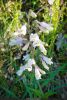
Penstemon pallidus is one of the smaller and daintier of the beardtongues. From its rosette of basal foliage, an upright, unbranched stem emerges in spring. It's topped with a showy panicle of delicate, white, trumpet-like flowers. The entire plant is no more than 2.5' tall. The stems, leaves, flowers, flower stalks, and flower pedicels (the individual stems of each flower) are covered in downy hairs. It blooms a little earlier than other Penstemon species (as early as April). Each flower forms a capsule that splits and releases tiny seeds that are light enough to be spread by the wind. Commonly known as pale beardtongue or eastern white beardtongue, this species is primarily a native of the Central Lowlands and Ozark Plateau of the Central U.S. Populations in the Northeastern U.S. are likely introduced by human activity. It's found in the tallgrass prairie, in limestone or sandstone glades, barrens, and other dry, disturbed sites like roadsides and railway corridors. This dainty beardtongue is a charming addition to a dry meadow or prairie garden, a mixed perennial planting, a path edge, or a rock garden.
Cultivation
Penstemon pallidus typically grows in habitats that are mesic to dry with poor soils. It's able to tolerate drought, heat, and humidity. It benefits from growing in poor soils where taller and more competitive plants might overwhelm it. Pale beardtongue does well in average garden soils that are dry to medium in moisture content and well drained. Avoid wet or poorly drained soils. Full to part sun is best, although it will tolerate a bit of shade. Pale penstemon develops a taproot and a caudex (a persistent base that is often woody). Deadheading can prolong the bloom, and the flowering stems can be cut back to the basal foliage after flowering for a tidier appearance.
Recommended Spacing
Space plants 6"-12" on center.
Penstemon pallidus has a spread of around 1.5', so the tight spacing will result in a dense cluster. Spacing further apart gives the plants some room and will give a more open effect. It will spread gently via seed but is not a aggressive.
Companion Plants
Combine pale beardtongue with other perennials that thrive in poor soils and sun but that aren't super tall or aggressive. Good companions include Asclepias tuberosa (butterfly milkweed), Antennaria plantaginifolia (plaintain-leaf pussytoes), Baptisia bracteata var. leucophaea (longbract wild indigo), Coreopsis lanceolata (lanceleaf tickseed), Dalea purpurea (purple prairie clover), Euphorbia corollata (flowering spurge), Monarda bradburiana (eastern beebalm), or Symphyotrichum oolentangiense (skyblue aster). Grass companions include Bouteloua curtipendula (sideoats grama), Sporobolus heterolepis (prairie dropseed), and Schizachyrium scoparium (little bluestem).
Additional Notes
The primarily pollinators of pale beardtongue are long-tongued bees, including honeybees, bumblebees, little carpenter bees, and mason bees. Deer tend to leave it alone. "Pale" in the common name and the Latin form in the specific epithet (pallidus) refer to the yellow hairs that line the throat of the corolla.

Pricing & Availability
Advance orders for spring
BUY MORE,
SAVE MORE
$25 off orders of $500 or more
$100 off orders of $1,000 or more
$200 off orders of $2,000 or more
15% off orders of $3,000 or more
Orders placed now can ship as early as the week of April 5th.
When you add plants to your cart, you will be prompted to select your preferred ship week for each item you add to your shopping cart.
You may choose to have your plants shipped later than the first available ship week, and you may also choose to stagger the shipments to meet your planting schedule.
Note on spring shipping: Early spring shipments might include plants that have not yet broken dormancy, or have not been vernalized and will be frost-tender.
Please use your best judgment when selecting your preferred ship week: When you add plants to your cart, a link to the average dates of last frost will be included in the pop-up.
Did you know? When plants are available from multiple growers, we list growers closest to your location first.
Choosing the growers closest to you makes it more likely the plants are consistent with your ecoregion, and lowers the shipping carbon footprint.
Advance orders for fall
BUY MORE,
SAVE MORE
$25 off orders of $500 or more
$100 off orders of $1,000 or more
$200 off orders of $2,000 or more
15% off orders of $3,000 or more
Orders placed now can ship as early as the week of August 17th.
When you add plants to your cart, you will be prompted to select your preferred ship week for each item you add to your shopping cart. You can elect to stagger your shipments to meet your planting schedule.
Note on fall shipping: Plants that ship late summer through fall may have been cut back prior to shipping. This does not affect the health or viability of the plants.
Please use your best judgment when selecting your preferred ship week.
Did you know? When plants are available from multiple growers, we list growers closest to your location first.
Why choose plants from the nearest grower? Choosing a the grower closest to you makes it more likely the plants are consistent with your ecoregion and better adapted to your location. In addition, shipping plants shorter distances typically uses fewer resources, something we can all get behind!
BUY MORE,
SAVE MORE
$25 off orders of $500 or more
$100 off orders of $1,000 or more
$200 off orders of $2,000 or more
15% off orders of $3,000 or more
Orders placed now can ship as early as the week of April 6th.
When you add plants to your cart, you will be prompted to select your preferred ship week for each item you add to your shopping cart. You can elect to stagger your shipments to meet your planting schedule. Would you like your plants shipped later? You may choose to do so in the shopping cart.
Would you like your plants shipped earlier? Please check with us BEFORE placing your order so that we can verify that your requirements can be met.
Note on spring shipping: Early spring shipments might include plants that have not yet broken dormancy, or have not been vernalized and will be frost-tender.
Please use your best judgment when selecting your preferred ship week.
Did you know? When plants are available from multiple growers, we list growers closest to your location first.
Why choose plants from the nearest grower? Choosing a the grower closest to you makes it more likely the plants are consistent with your ecoregion and better adapted to your location. In addition, shipping plants shorter distances typically uses fewer resources, something we can all get behind!
Maps, Wetland Status & More
MAP OF NATIVE RANGE
Recorded County Distribution: USDA data/BONAP
Native To
| AL, AR, CT, DC, GA, IA, IL, IN, KS, KY, MA, MD, ME, MI, MN, MO, NC, NH, NJ, NY, OH, PA, RI, TN, VA, VT, WI |
Legal Status
Wetland Status
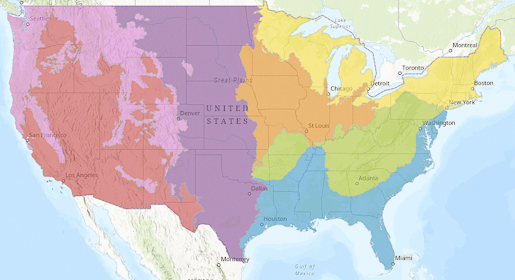
| Atlantic and Gulf Coastal Plain | FACU |
| Eastern Mountains and Piedmont | FACU |
| Great Plains | FACU |
| Midwest | UPL |
| Northcentral and Northeast | UPL |
MAP OF WETLAND DELINEATION REGIONS
Interpreting Wetland Status
|
Code |
Status |
Designation |
Comment |
|
OBL |
Obligate Wetland |
Hydrophyte |
Almost always occur in wetlands |
|
FACW |
Facultative Wetland |
Hydrophyte |
Usually occur in wetlands, but may occur in non-wetlands |
|
FAC |
Facultative |
Hydrophyte |
Occur in wetlands and non-wetlands |
|
FACU |
Facultative Upland |
Nonhydrophyte |
Usually occur in non-wetlands, but may occur in wetlands |
|
UPL |
Obligate Upland |
Nonhydrophyte |
Almost never occur in wetlands |
Classification
| Kingdom | Plantae | Plants |
| Subkingdom | Tracheobionta | Vascular plants |
| Superdivision | Spermatophyta | Seed plants |
| Division | Magnoliophyta | Flowering plants |
| Class | Magnoliopsida | Dicotyledons |
| Subclass | Asteridae | |
| Order | Scrophulariales | |
| Family | Scrophulariaceae | Figwort family |
| Genus | Penstemon | beardtongue |
| Species | Penstemon pallidus | pale beardtongue |
ADDITIONAL COMMON NAMES:
eastern white beardtongue
Plant Sizes
Sizes Sizes
Sizes info
Shipping & Planting
SHIPPING INFO:
Shipping is free on all plants orders!
Your plants will ship using each grower’s preferred method: FedEx Ground, UPS Ground, or Spee-Dee Ground (in select midwestern states). Our growers ship orders Monday through Wednesday. The farther your plants need to travel, the earlier in the week they will ship. The goal is to have all plants delivered by the end of the week.
Shipping plugs:
Plugs are shipped in full flats, sometimes also referred to as trays. Multiple flats can be shipped in a single box. The flats are wrapped in netting or craft paper to secure the plants, and spacers are used between flats to keep the plants from being crushed.
When you unpack your plugs, the plants will have been somewhat flattened by the netting or craft paper. They will straighten out within a couple of days. You may also gently “fluff” them a bit to speed up the process. In some cases, your plants might have been cut back before packing, if the grower deemed them to have become too tall for safe packaging. Don’t worry, though, these guys know what they’re doing and would not compromise the health of the plants. They’ll fill back in in no time.
After receiving your plants’ journey in a dark box, it will be important to acclimate them to sunlight again. Over a couple of days, you should gradually move them into their preferred light exposure, and water them as per their requirement.
Although we always recommend putting your plants in the ground as soon as possible, they can stay healthy in the flats for a considerable amount of time. The key is to respect their growing requirements: if the species requires full sun, do not store them in the shade. If it is best adapted to dry soil, do not over-water.
PLANTING INFO:
Planting plugs:
We consider plugs ready to ship when the plants’ roots have filled the entire liner cell and the plants can easily be pulled out. In some cases you will have to go about it gently, wiggling the plant by the crown, and possibly squeezing the bottom of the liner to compress the growing medium and release the roots. Other times, the plants will appear to be root bound. They are not in the traditional sense. The plants are healthy but they have used up all the growing medium available to them. Plugs are at an aggressive stage of growth. As soon as planted the roots will immediately expand into your native soil. They establish faster than plants in larger containers, because they don’t have the luxury of a lot of growing media that can inhibit the roots from venturing outside of their comfort zone.
We are not going to address area preparation because the process can be complex and is always site-specific. However, as a rule, we recommend disturbing the soil as little as possible, and we do not recommend amending the soil. If you chose the right plant for the right conditions they will thrive. Any disturbance and amendments will only encourage weeds to emerge that never had a chance to do so before.
Installing plugs cannot be easier: dig a hole large enough for the roots to fit snugly inside, plant so that the crown is level with the surrounding soil, then water them in to eliminate air gaps. We recommend using a soil knife, sometimes referred to as hori hori, or a drill-adapted auger if it’s a large installation. If you use an auger, you will need a powerful drill. Depending on the size of the project and the type of soil, the process can be beyond what an average drill will bear. Mulching is recommended after installation to help keep weeds down while the plants establish. Be sure to keep it a couple of inches away from the crown of the plants. For large projects, you may want to mulch the area before planting, rather than tiptoeing through it after the fact. As a side note: if you are installing plugs in the fall, you might want to plant them so that the crown is about ¾” lower than the surrounding soil. The winter’s freeze/thaw cycles can push plugs out if the roots did not have enough time to establish and anchor them in.