
Please check the average dates of last frost for your area before choosing your ship weeks.
Search
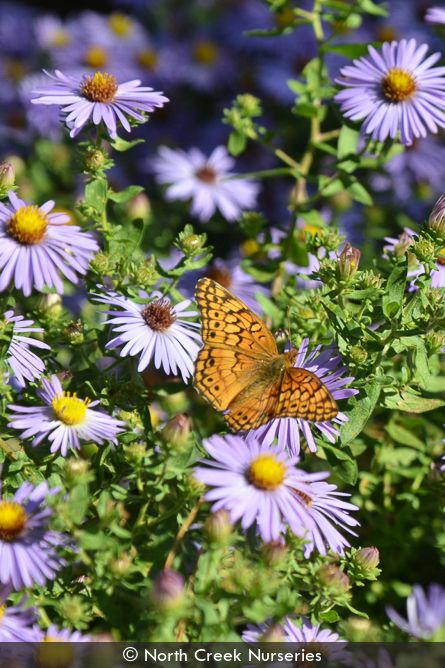
Symphyotrichum oblongifolium 'Twilight Sky' Twilight Sky aromatic aster
Twilight Sky aromatic aster


As low as:
$203.50 per 50-count regular plugs, full flat (50 plugs) - $4.07 each.
Other sizes may also be available.
Characteristics
Descriptions
Light Requirements
sun
Soil Moisture
moist
Soil Description
average, poor, loam, clay, sand, gravel/rock
Height
3'-4'
Recommended Spacing
2'
Bloom Time
September, October, November
Bloom Color
violet, lavender, blue
Hardiness Zone
5, 6, 7, 8, 9
Description
If you love fall-blooming asters, then 'Twilight Sky' gives you more of what you love. This cultivar of Symphyotrichum oblongifolium is a prolific bloomer, covering itself in hundreds of oversize, periwinkle-blue flowers that draw in late-season pollinators. Its dense habit creates a mound of aster awesomeness up to 4' in height. Like the wild type, its leaves are smooth, oblong, and fragrant, hence the common name of aromatic aster. 'Twilight Sky' lights up cottage gardens, shines in mixed perennial plantings, and brings gorgeous color to a meadow planting.
Cultivation
Aromatic aster prefers full sun, poor soil, and dry conditions, but it will be happy most anywhere with good drainage and lots of sun. It is heat tolerant and especially likes south or west-facing slopes. In moist, fertile soils, it can be outcompeted by more taller, more aggressive species. To keep it shorter and more compact, it can be cut back by 1/3 to 1/2 the height in late spring (the Chelsea chop).
Recommended Spacing
Space plants 2' on center.
Companion Plants
Aromatic aster combines with many other showy, pollinator-attracting perennials, including Coreopsis palmata (stiff tickseed), Liatris aspera (tall blazing star), Ruellia humilis (wild petunia), Echinacea pallida (pale purple coneflower, Eryngium yuccifolium (button eryngo), Coreopsis tripteris (tall tickseed), Penstemon digitalis (foxglove beardtongue), Asclepias tuberosa (butterfly milkweed), and Rudbeckia fulgida (orange coneflower). On the grassy side, you can't go wrong pairing it with Sporobolus heterolepis (prairie dropseed), Bouteloua curtipendula (sideoats grama), Bouteloua gracilis (blue grama), or Koeleria macrantha (prairie junegrass).
Additional Notes
Symphyotrichum oblongifolium 'Twilight Sky' shares keystone status with the asters, a group of perenials that make major contributions to the foodweb in local habitats.

Pricing & Availability
Advance orders for spring
BUY MORE,
SAVE MORE
$25 off orders of $500 or more
$100 off orders of $1,000 or more
$200 off orders of $2,000 or more
15% off orders of $3,000 or more
Orders placed now can ship as early as the week of April 5th.
When you add plants to your cart, you will be prompted to select your preferred ship week for each item you add to your shopping cart.
You may choose to have your plants shipped later than the first available ship week, and you may also choose to stagger the shipments to meet your planting schedule.
Note on spring shipping: Early spring shipments might include plants that have not yet broken dormancy, or have not been vernalized and will be frost-tender.
Please use your best judgment when selecting your preferred ship week: When you add plants to your cart, a link to the average dates of last frost will be included in the pop-up.
Did you know? When plants are available from multiple growers, we list growers closest to your location first.
Choosing the growers closest to you makes it more likely the plants are consistent with your ecoregion, and lowers the shipping carbon footprint.
Advance orders for fall
BUY MORE,
SAVE MORE
$25 off orders of $500 or more
$100 off orders of $1,000 or more
$200 off orders of $2,000 or more
15% off orders of $3,000 or more
Orders placed now can ship as early as the week of August 17th.
When you add plants to your cart, you will be prompted to select your preferred ship week for each item you add to your shopping cart. You can elect to stagger your shipments to meet your planting schedule.
Note on fall shipping: Plants that ship late summer through fall may have been cut back prior to shipping. This does not affect the health or viability of the plants.
Please use your best judgment when selecting your preferred ship week.
Did you know? When plants are available from multiple growers, we list growers closest to your location first.
Why choose plants from the nearest grower? Choosing a the grower closest to you makes it more likely the plants are consistent with your ecoregion and better adapted to your location. In addition, shipping plants shorter distances typically uses fewer resources, something we can all get behind!
BUY MORE,
SAVE MORE
$25 off orders of $500 or more
$100 off orders of $1,000 or more
$200 off orders of $2,000 or more
15% off orders of $3,000 or more
Orders placed now can ship as early as the week of April 6th.
When you add plants to your cart, you will be prompted to select your preferred ship week for each item you add to your shopping cart. You can elect to stagger your shipments to meet your planting schedule. Would you like your plants shipped later? You may choose to do so in the shopping cart.
Would you like your plants shipped earlier? Please check with us BEFORE placing your order so that we can verify that your requirements can be met.
Note on spring shipping: Early spring shipments might include plants that have not yet broken dormancy, or have not been vernalized and will be frost-tender.
Please use your best judgment when selecting your preferred ship week.
Did you know? When plants are available from multiple growers, we list growers closest to your location first.
Why choose plants from the nearest grower? Choosing a the grower closest to you makes it more likely the plants are consistent with your ecoregion and better adapted to your location. In addition, shipping plants shorter distances typically uses fewer resources, something we can all get behind!
Plant Sizes
Sizes Sizes
Sizes info