
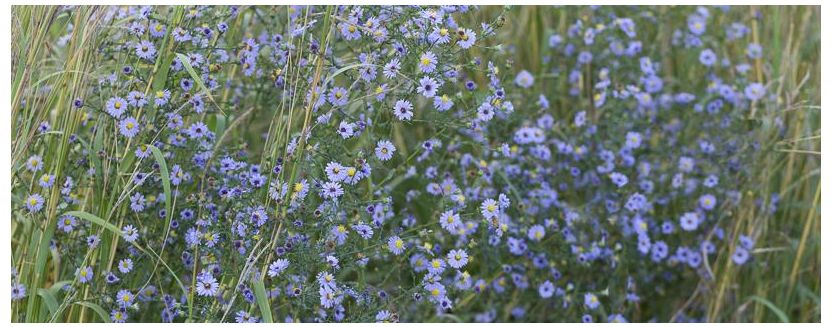
As the growing season comes to a close and the dominant yellow palette led by goldenrods will soon begin to fade, asters are ready to step in and provide a final hoorah.
For a late season burst of color few plants are as rewarding as the asters (now moved into the tongue-twisting Symphyotrichum genus). And, topping the list, are the blue-flowering asters.
With flowers ranging from blue to purple, some of which will persist well through frost, these fall bloomers will stand out in spectacular fashion against the backdrop of native grasses that will soon be taking on yellow and orange hues as they enter dormancy.

The tallest of these asters is Symphyotrichum novae-angliae (New England aster). Towering at up to 6’ tall, its 2” flowers are correspondingly large. Bloom color is highly variable with hues ranging from blue to pink and purple. It is easy to grow under full to part-sun and in average, moist, well-drained soil. For an ideal companion grass, consider species within the Andropogon genus (big bluestem). They have comparable growing requirements, are similar in stature, and will provide a strong vertical accent with excellent fall colors.
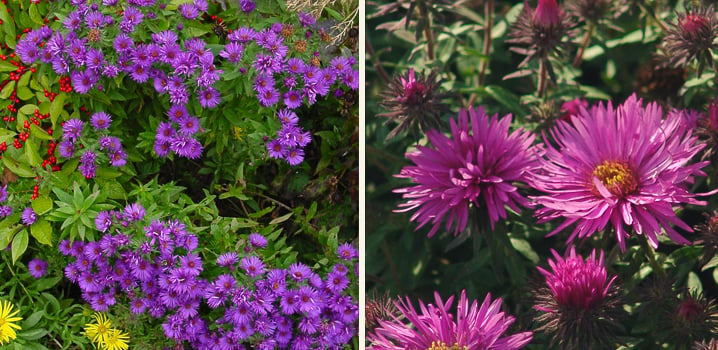
For more compact plants and predictable color, the two stand-out cultivars are Symphyotrichum novae-angliae 'Purple Dome' - with vibrant purple flowers - and Symphyotrichum novae-angliae 'Vibrant Dome' - with hot pink flowers. The former tops out at about 2’, and the latter is a bit shorter yet.
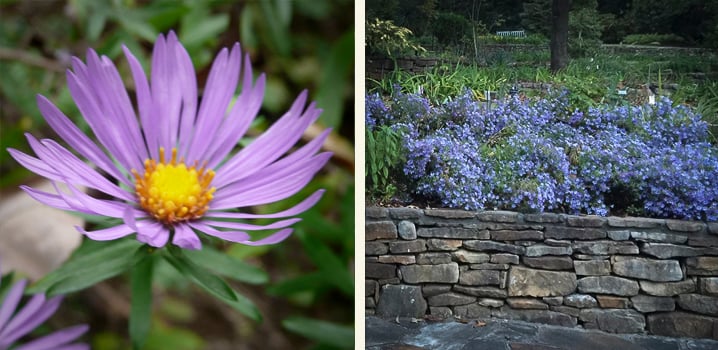
Our favorite fall-blooming aster is probably Symphyotrichum oblongifolium (aromatic aster). To be clear, the leaves are the fragrant part of the plant, not the flowers. It grows to about 3’ tall with a nice, mounding habit and is a profuse bloomer with flowers that are typically vibrant blue but that can be highly variable as with most asters. It is also one of the latest flowering perennials to bloom and will go strong until heavy frosts settle in. Aromatic aster is a low-maintenance species that thrives under full to part-sun, and in average, moist to dry soil. This species is more tolerant of dry conditions than the aforementioned Symphyotrichum novae-angliae, and is well suited for rock gardens. For a companion grass, it is best paired with low-growing species such as Schizachyrium scoparium (another mouthful), commonly known as little bluestem. For options in growing habit and autumn hues, little bluestem cultivars are also good choices.
There are two noteworthy cultivars of Symphyotrichum oblongifolium: 'Raydon's Favorite' which is slightly shorter and denser than the species, and ‘October Skies’ which is shorter yet and has more consistently blue flowers.
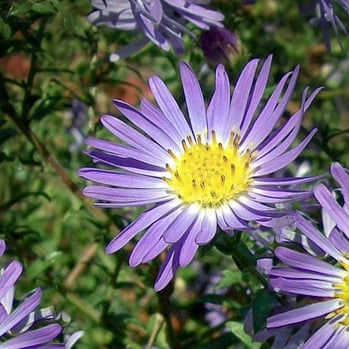
Almost as tall as the New England aster is Symphyotrichum novi-belgii (New York aster). It typically tops off at 5’ with 1” flowers that come in muted shades of blue, pink, sometimes even near white. One of the benefits of the species is its extraordinary adaptability. New York aster is not particular about soil and will easily withstand dry spells as well as periodic inundations which makes it a particularly good choice for rain gardens. It also has a high degree of salt tolerance and is a good option for plantings near roads, sidewalks, and other areas that are regularly treated through the winter months.
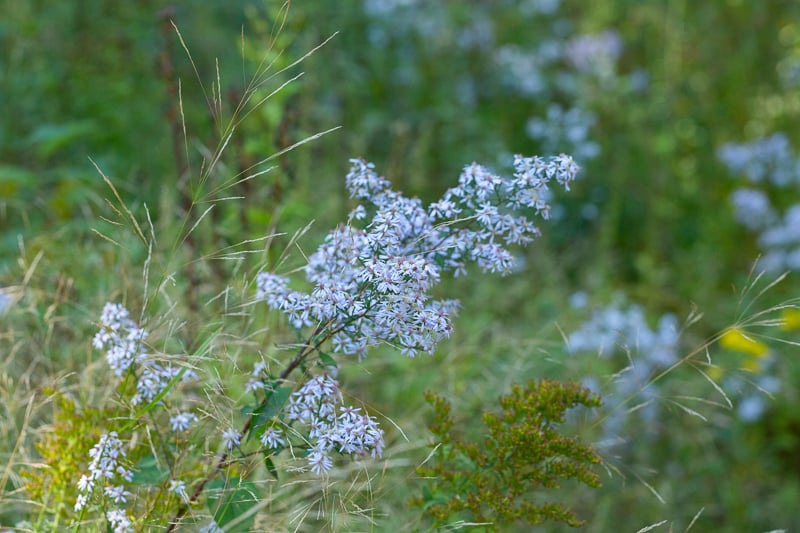
For a shadier spot in the garden, Symphyotrichum cordifolium (blue wood aster) is a good selection. It does very well in full sun but is more tolerant of shade than other sun-loving asters. This is a profuse, late season bloomer with small flowers - not exceeding ½” across - that emerge in pale shades of blue that will intensify as they age.
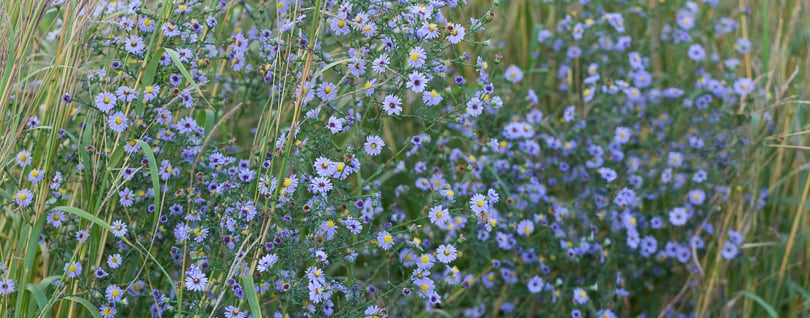
Too often overlooked, and well-deserving of more attention and a prominent spot in the garden, is Symphyotrichum laeve (smooth blue aster). Rarely exceeding a height of 3’, it is naturally compact with a dense habit and robust stems that will not flop. It is a profuse bloomer with flowers that are up to 1” across and range in color from light blue to light violet. Smooth blue aster is easy to grow in average, moist to dry, well-drained soil in full to part-sun.
So, when it comes to planning the fall garden, look towards the asters (literally derived from the Greek word for stars). And, just like actual stars, there are myriads of them to contemplate. There are probably more varieties of horticulturally available plants in the Symphyotrichum genus, than there are in any other genus of ornamental forbs and herbs. This blog post barely scratches the surface, so take a look around for the aster that best meets your needs and go ahead and showcase your autumn blues.
So, what’s up with botanical names?
The genus, Symphyotrichum, is derived from the Greek symph meaning coming together or grouped (think symphony), and the Greek thrix meaning hair and a possible reference to the thin flower rays or its anthers. The specific epithet is simply the Latinized translation of New England.
Most species in the genus were previously lumped together in the Aster (from the Greek word for stars) genus. So why the change, to the great dismay of anybody trying to pronounce Symphyotrichum? Rather than paraphrase an answer, I will defer to an expert:
“In 1994, a study of asters world-wide indicated that the native Eurasian species stand apart from the North American ones. The name Aster is most appropriately associated with the Eurasian species, leaving the approximately 180 North American species to find names within other genera. By far the largest number of the North American species transferred from Aster to other genera are now in Symphyotrichum (about 90 species). Other North American genera where the ‘old’ asters are now located are Almutaster, Ampelaster, Aster [only 2 North American species remain in this genus], Canadanthus, Chloracantha, Doellingeria, Eucephalus, Eurybia, Oclemena, Oreostemma, and Sericocarpus.
Some of these Latinized scientific names were ‘invented’ and published long ago and, by the rules of nomenclature, must be used. The ‘principle of priority’ establishes that the first name published in a specified manner is the correct one. Symphyotrichum, which displaces the more euphonious Aster in the majority of the species, seems especially peculiar and tongue-twisting, and although it has almost never been used until very recently, it was first proposed in 1832 and can’t be denied its rightful place.”
Guy Nesom (UNC Botany Ph.D. 1980)

Claudio Vazquez co-founded Izel Plants in 2009 to fill the gap in online information about native plants that was pervasive at the time. With an initial focus on describing horticulturally available native plants, Izel Native Plants has since evolved into one of the top destinations for purchasing native plants online.

