
Please check the average dates of last frost for your area before choosing your ship weeks.
Search
PLANTS NATIVE TO INDIANA'S ECOREGIONS
Below is a listing of all the plants native to the state of Indiana that are currently available for sale through Izel Native Plants. This listing will change from month to month, or even from day to day, as some species become sold out and other crops become ready to ship to our customers.
Jump to bottom of page for Indiana Ecoregions Map












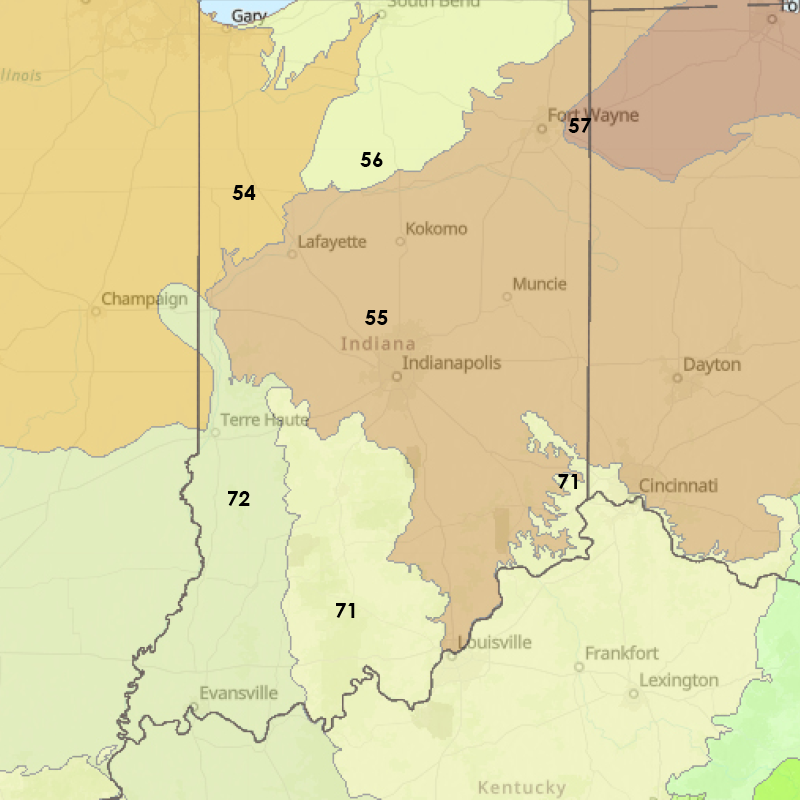
Indiana Ecoregions - EPA Level 3
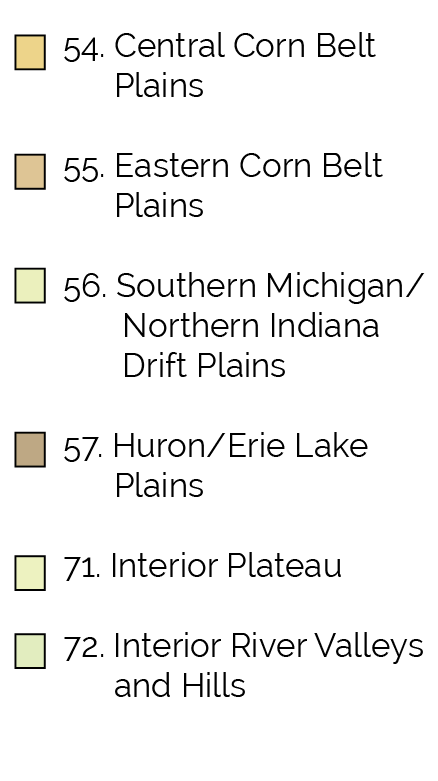
54. Central Corn Belt Plains
- The Central Corn Belt Plains ecoregion is a transitional area from the once dominant hardwood forests to the east and the extensive native prairie communities to the west. Beginning in the nineteenth century, the natural vegetation was gradually replaced by agriculture. Farms are now extensive on the dark, fertile soils. It is a broad ecoregion, with an irregular outline, that spans from western Indiana to southern Wisconsin and is centered in northeastern Illinois.
55. Eastern Corn Belt Plains
- The Eastern Corn Belt Plains is the dominant ecoregion in Indiana and also covers most of the western half of Ohio. It is primarily a rolling till plain with local end moraines and extensive Wisconsinian glacial deposits. The soil is well-drained and rich. While forests once dominated the region, most have been cleared for agricultural purposes.
56. Southern Michigan/Northern Indiana Drift Plains
- Southern Michigan/Northern Indiana Drift Plains is an ecoregion characterized by its many lakes and marshes as well as its wide assortment of landforms, soil types, soil textures, and land uses. Bogs and bog soils are also locally common. It is the dominant ecoregion of southern Michigan and extends southward into Indiana.
57. Huron/Erie Lake Plains
- The Huron/Erie Lake Plains ecoregion is a broad, fertile, nearly flat plain punctuated by relict sand dunes, beach ridges, and end moraines. Spanning from the shores of Lake Erie in Ohio, to the shores of Lake Huron in Michigan, it only extends to a small area of northeastern Indiana. The soil was originally poorly drained before being cleared to make way for agriculture. Original coverage was a mix of elm-ash swamp and beech forests, with some mixed oak forests, and on sandier sites such as beaches and dunes, open oak savannas.
71. Interior Plateau
- The Interior Plateau ecoregion is diverse, and extends from northern Alabama, through central Tennessee and western Kentucky, into southeastern Indiana. Open hills, irregular plains, and tablelands are typical of the region. The climate is more humid than in its surrounding ecoregions, but the area also benefits from more regular rainfall. The natural vegetation is primarily oak-hickory forest and cedar glades, and some bluestem prairies.
72. Interior River Valleys and Hills
- The Interior River Valleys and Hills ecoregion extends westward and north from Kentucky, through southwestern Indiana, into Illinois, and Missouri. It is made up of nearly level lowlands that are dominated by agriculture and forested hills. It is characteristically underlain by carboniferous sedimentary rock. Wetlands are common on lowlands and bottomlands. Bottomland deciduous forests and swamp forests were once extensive on poorly-drained, nearly level, lowland sites but most have been replaced by cropland and pastureland. Hilly uplands remain mostly forested.
To view, or download, a pdf of the entire map of the U.S. Level III Ecoregions, go to the following link:
EPA Data Commons Ecoregion Level III pdf