
Please check the average dates of last frost for your area before choosing your ship weeks.
Search
PLANTS NATIVE TO IOWA'S ECOREGIONS
Below is a listing of all the plants native to the state of Iowa that are currently available for sale through Izel Native Plants. This listing will change from month to month, or even from day to day, as some species become sold out and other crops become ready to ship to our customers.
Jump to bottom of page for Iowa Ecoregions Map







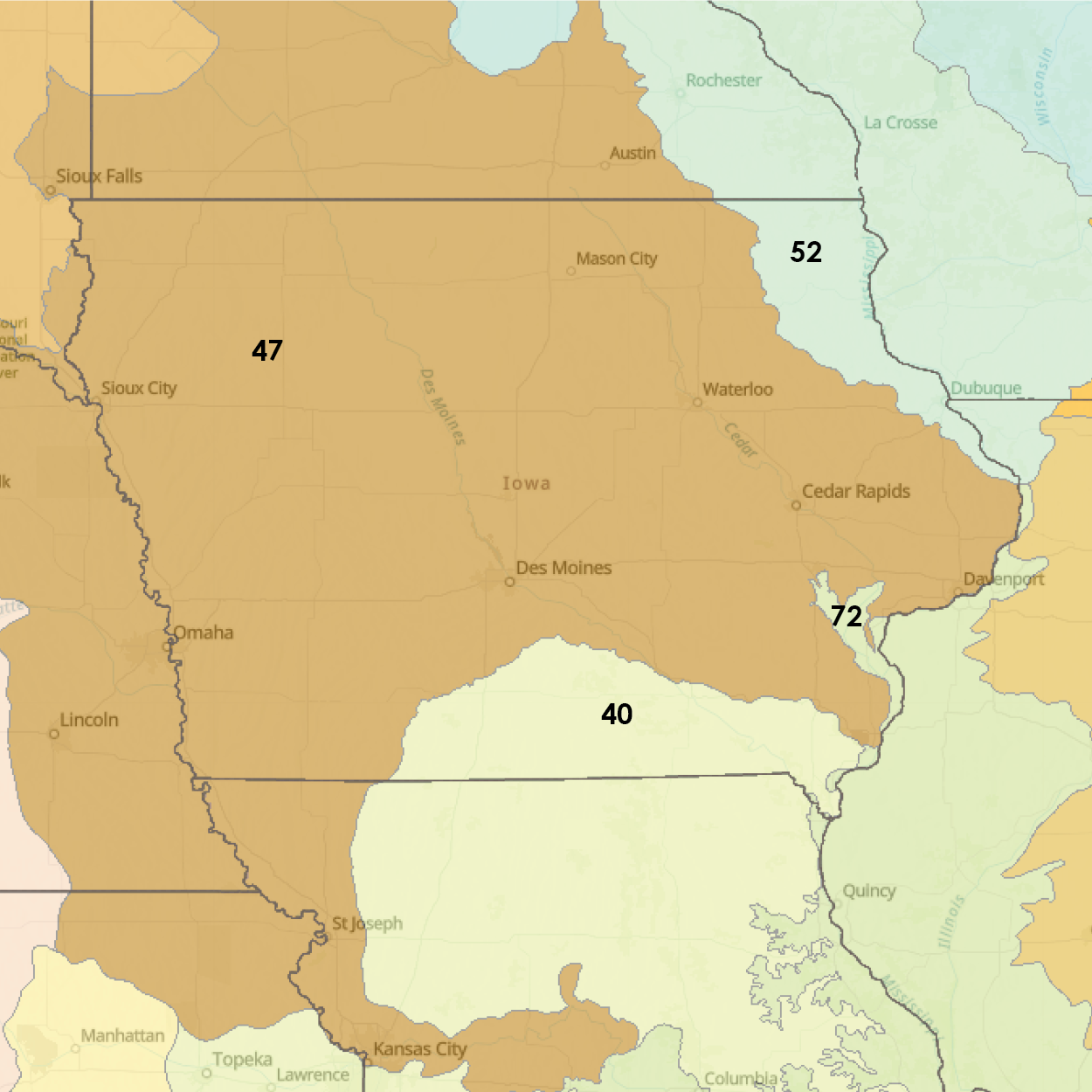
Iowa Ecoregions - EPA Level 3
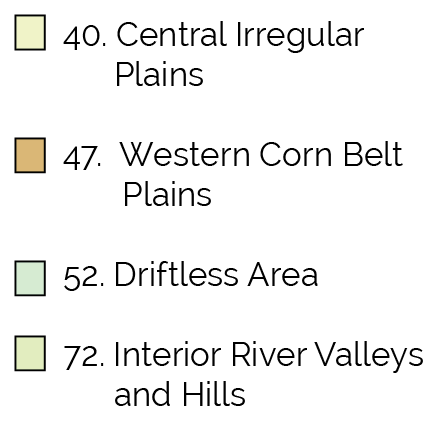
40. Central Irregular Plains
- The Central Irregular Plains ecoregion is a disjunct ecoregion with one portion occurring in northern Missouri and south-central Iowa, and another portion occurring in eastern Kansas, western Missouri, and northeastern Oklahoma. The ecoregion has a variety of land use types and tends to be topographically more irregular than the Western Corn Belt Plains (47) to the north, where most of the land is in crops. The potential natural vegetation of the region is a mosaic of tallgrass prairie and oak-hickory forest, with more forested areas than 47. The climate is humid with rainfall averaging 28 to 40 inches per year, most of it falling during the growing season.
47. Western Corn Belt Plains
- The Western Corn Belt Plains ecoregion runs across several states of the Upper Midwest, including most of Iowa, and the western section of Nebraska. Once covered with tall-grass prairie, over 75 percent of the Western Corn Belt Plains is now used for cropland agriculture, and much of the remainder is in forage for livestock. A combination of nearly level to gently rolling till plains and hilly loess plains, an average annual precipitation of 63–89 cm, which occurs mainly in the growing season, and fertile, warm, moist soils make this one of the most productive areas of corn and soybeans in the world.
52. Driftless Area
- The Driftless Area is a region that was spared by the scouring effects of glaciation and is characterized by steep hillsides, narrow, deeply carved valleys, and a land marked by unevenness. It also lacks the glacial deposits - known as drifts - of the surrounding regions, hence its name. Ecologically, the ecoregion more closely resembles those of the Great Lakes region and New England, than the surrounding ones. It has an ovoid shape, oriented from northwest to southeast, and sits over the junction of Minnesota, Iowa, and Wisconsin.
72. Interior River Valleys and Hills
- The Interior River Valleys and Hills ecoregion extends westward and north from Kentucky, through southwestern Indiana, Illinois, and central Missouri. In Iowa, it only accounts for a small region of the southeastern part of the state. It is made up of nearly level lowlands that are dominated by agriculture and forested hills. The ecoregion is characteristically underlain by carboniferous sedimentary rock. Wetlands are common on lowlands and bottomlands. Bottomland deciduous forests and swamp forests were once extensive on poorly-drained, nearly level, lowland sites but most have been replaced by cropland and pastureland. Hilly uplands remain mostly forested.
To view, or download, a pdf of the entire map of the U.S. Level III Ecoregions, go to the following link:
EPA Data Commons Ecoregion Level III pdf