
Please check the average dates of last frost for your area before choosing your ship weeks.
Search
PLANTS NATIVE TO NORTH CAROLINA'S ECOREGIONS
Below is a listing of all the plants native to the state of North Carolina that are currently available for sale through Izel Native Plants. This listing will change from month to month, or even from day to day, as some species become sold out and other crops become ready to ship to our customers.
Jump to bottom of page for North Carolina Ecoregions - EPA Ecoregions Level III

-

-
-
-
-
-
-
-
-
-
-
- NEW
-
-
-
-
-
-
-
-
-
-
-
-
-
-
-
-
-

-
-
-










North Carolina Ecoregions - EPA Level 3
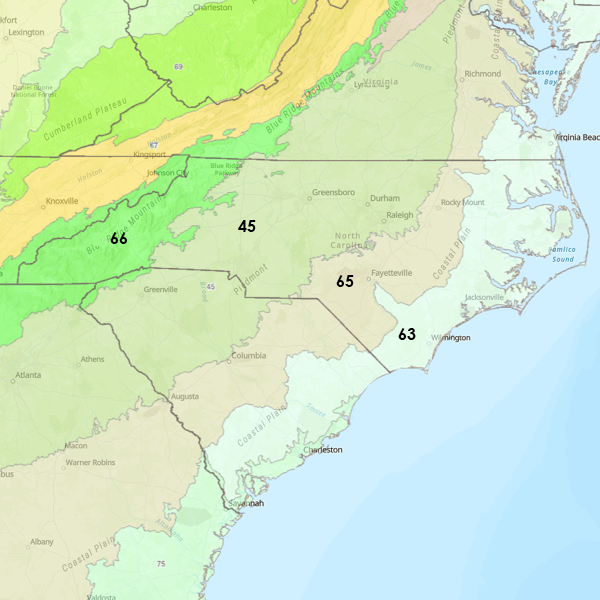
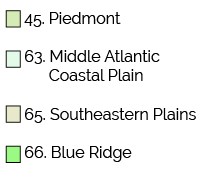
45. Piedmont
- The Piedmont is a transitional ecoregion between the mostly mountainous ecoregions of the Appalachians to the west and the lower, more level ecoregions of the coastal plain to the east. It extends from Northern Virginia, through central North Carolina, and south to Alabama. The area is largely wooded and consists of irregular plains, low rounded hills and ridges, and shallow valleys.
63. Middle Atlantic Coastal Plain
- The Middle Atlantic Coastal Plain is an ecoregion covering most of the coastal plain from the South Carolina-Georgia border, northeast to southern New Jersey. It covers the eastern section of North Carolina, including the Outer Banks. This region tends to be flat with well-drained sandy soil, dunes, beaches, and barrier islands along the coastline, usually with extensive and poorly-drained wetlands and swampy areas behind them.
65. Southeastern Plains
- The Southeastern Plains ecoregion encompasses much of the coastal plain of the southeastern U.S., stretching from Maryland, through North Carolina, south to the Florida panhandle and Louisiana, hooking below the Appalachians back north to western Tennessee. This region is relatively flat, with elevations ranging from sea level to about 300 feet. Its soil is a diverse mix of sands, silts, and clays.
66. Blue Ridge
- The Blue Ridge ecoregion is a narrow strip of mountainous ridges and hilly plateaus that extend from southern Pennsylvania, Maryland and Virginia to northern Georgia. It is at its widest in western North Carolina where it is also the easternmost ecoregion of the state. Climate and vegetation vary significantly from north to south, with the southern portion being one of the richest centers of biodiversity in the eastern U.S. and home to a large number of endemic species of plants.
To view, or download, a pdf of the entire map of the U.S. Level III Ecoregions, go to the following link:
EPA Data Commons Ecoregion Level III pdf