
Please check the average dates of last frost for your area before choosing your ship weeks.
Search
PLANTS NATIVE TO TENNESSEE
Below is a listing of all the plants native to the state of Tennessee that are currently available for sale through Izel Native Plants. This listing will change from month to month, or even from day to day, as some species become sold out and other crops become ready to ship to our customers.
Jump to bottom of page for Tennessee Ecoregions - EPA Ecoregions Level III












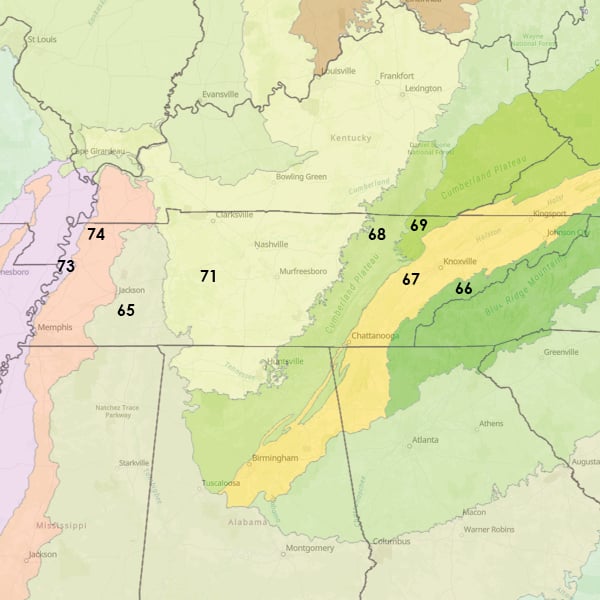
Tennessee Ecoregions - EPA Level 3
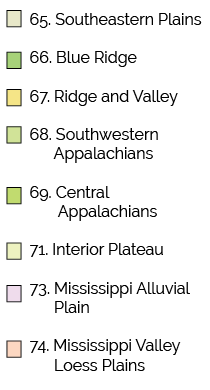
65. Southeastern Plains
- The Southeastern Plains ecoregion encompasses much of the coastal plain of the southeastern U.S., stretching from Maryland, through Alabama, south to the Florida panhandle and Louisiana, hooking below the Appalachians back north to western Tennessee. This region is relatively flat with a diverse mix of sandy, silty, and clayey soils. Natural vegetation includes oak-hickory-pine and Southern mixed forest. Cropland and pastures are also abundant.
66. Blue Ridge
- The Blue Ridge ecoregion is a narrow strip of mountainous ridges and hilly plateaus that extend from southern Pennsylvania to northeastern Georgia and represents the easternmost border of Tennessee. Climate and vegetation vary significantly from north to south, with the southern portion being one of the richest centers of biodiversity in the eastern U.S. and home to a large number of endemic species of plants.
67. Ridge and Valley
- The Ridge and Valley is a northeast-southwest trending ecoregion that spans from New York, through eastern Tennessee, to Alabama. It is relatively low-lying with roughly parallel ridges and valleys that have a variety of widths, heights, and geologic materials. It extends along almost the entire length of the Appalachian mountains. Climate and vegetation vary significantly from north to south, with microclimates and vegetation varying significantly between ridges and valleys.
68. Southwestern Appalachians
- The Southwestern Appalachians ecoregion stretches southwestward from Kentucky, through central Tennessee, to Alabama. The area is characterized by warmer and more humid climate than in most of the Appalachian range. The mountains are open and low, and only slightly notched by small eastward drainage in the region’s eastern boundary. Cover consists of a mosaic of forest and woodland with some cropland and pasture.
69. Central Appalachians
- The Central Appalachian is an ecoregion that extends from Pennsylvania, through eastern West Virginia, to northeastern Tennessee. It is primarily a high, dissected, rugged plateau with numerous long ridges running through it. Extensive forest cover is representative of this region. Cool climate, and infertile soils have led to limited agriculture in the area.
71. Interior Plateau
- The Interior Plateau ecoregion is diverse, and extends from southern Indiana and Ohio to northern Alabama, and covers a large section of Tennessee centered around Nashville. Open hills, irregular plains, and tablelands are typical of the region. The climate is more humid than in its surrounding ecoregions, but the area also benefits from more regular rainfall. The natural vegetation is primarily oak-hickory forest and cedar glades, and some bluestem prairies. It is an important agricultural region for Alabama.
73. Mississippi Alluvial Plain
- The Mississippi Alluvial Plain is a riverine ecoregion that extends from southern Illinois, at the confluence of the Ohio River with the Mississippi River, south to the Gulf of Mexico. In Tennessee, it is a narrow strip on the western border of the state, along the Mississippi River, and west of Memphis. It is mostly a flat, broad floodplain with river terraces and levees providing the main elements of relief. Soil is variable and includes alluvial sand, silt, clay, and gravel. Original vegetation included hardwood forests of oak tupelo, and bald cypress, but most of the forest cover has given way to extensive cropland.
74. Mississippi Valley Loess Plains
- The Mississippi Valley Loess Plains ecoregion stretches from southwestern Kentucky, through western Tennessee, south to Louisiana. It consists primarily of irregular plains, with oak-hickory and oak-hickory-pine natural vegetation, with agriculture being the dominant land use in Tennessee. Thick loess tends to be the distinguishing soil characteristic..
To view, or download, a pdf of the entire map of the U.S. Level III Ecoregions, go to the following link:
EPA Data Commons Ecoregion Level III pdf