
Please check the average dates of last frost for your area before choosing your ship weeks.
Search
PLANTS NATIVE TO VIRGINIA
Below is a listing of all the plants native to the state of Virginia that are currently available for sale through Izel Native Plants. This listing will change from month to month, or even from day to day, as some species become sold out and other crops become ready to ship to our customers.
Jump to bottom of page for Virginia Ecoregions - EPA Ecoregions Level III











Virginia Ecoregions - EPA Level 3
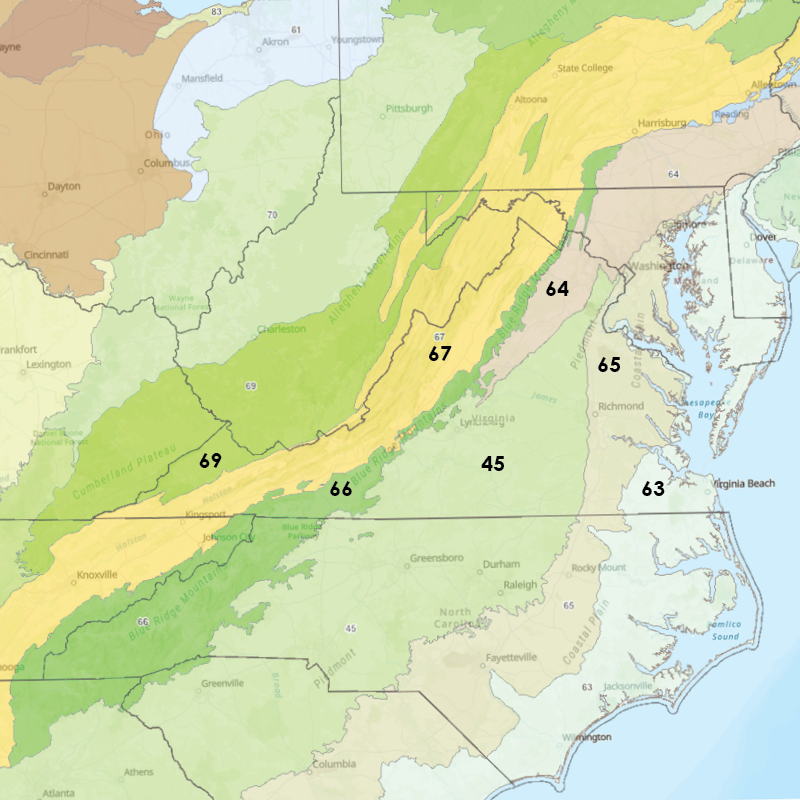
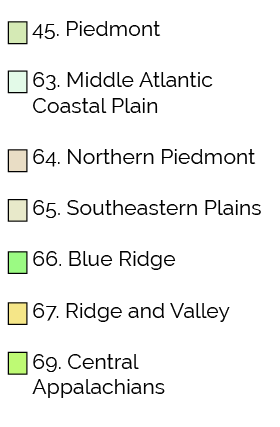
45. Piedmont
- The Piedmont is a transitional ecoregion between the mostly mountainous ecoregions of the Appalachians to the west and the lower, more level ecoregions of the coastal plain to the east. It extends from Northern Virginia south to Alabama. The area is largely wooded and consists of irregular plains, low rounded hills and ridges, and shallow valleys.
63. Middle Atlantic Coastal Plain
- The Middle Atlantic Coastal Plain is an ecoregion covering most of the coastal plain from the South Carolina-Georgia border, northeast to southern New Jersey, and includes the Virginia Eastern Shore and Tidewater. This region tends to be flat with well-drained sandy soil, dunes, beaches, and barrier islands along the coastline, usually with extensive and poorly-drained wetlands and swampy areas behind them.
64. Northern Piedmont
- The Piedmont is a transitional ecoregion between the mostly mountainous ecoregions of the Appalachians to the west and the lower, more level ecoregions of the coastal plain to the east. It extends from Northern Virginia south to Alabama. The area is largely wooded and consists of irregular plains, low rounded hills and ridges, and shallow valleys.
65. Southeastern Plains
- The Southeastern Plains region encompasses much of the coastal plain of the southeastern U.S., stretching from Maryland and Virginia south to the Florida panhandle and Louisiana, hooking below the Appalachians back north to western Tennessee. This region is relatively flat, with elevations ranging from sea level to about 300 feet. Its soil is a diverse mix of sands, silts, and clays.
66. Blue Ridge
- The Blue Ridge is a narrow strip of mountainous ridges and hilly plateaus that extend from southern Pennsylvania, Maryland and Virginia to northern Georgia. It is at its widest in western North Carolina. Climate and vegetation vary significantly from north to south, with the southern portion being one of the richest centers of biodiversity in the eastern U.S. and home to a large number of endemic species of plants.
67. Ridge and Valley
- The Ridge and Valley is a northeast-southwest trending ecoregion, relatively low-lying, and sandwiched between generally higher, more rugged mountainous regions. It extends along almost the entire length of the Appalachian mountains and is the dominant ecoregion of Virginia’s section of the Appalachians. Its northern limit includes a narrow strip in New York and New Jersey, and its southern limit is in central Alabama. Climate and vegetation vary significantly from north to south, with microclimates and vegetation varying significantly between ridges and valleys.
69. Central Appalachians
- The Central Appalachian is an ecoregion that includes parts of south central Pennsylvania, eastern West Virginia, and a small area in southwestern Virginia and northeastern Tennessee. It is primarily a high, dissected, rugged plateau with numerous long ridges running through it. Extensive forest cover is representative of this region, and its few open areas are typically the result of human intervention to create pastures for livestock.
To view, or download, a pdf of the entire map of the U.S. Level III Ecoregions, go to the following link:
EPA Data Commons Ecoregion Level III pdf