
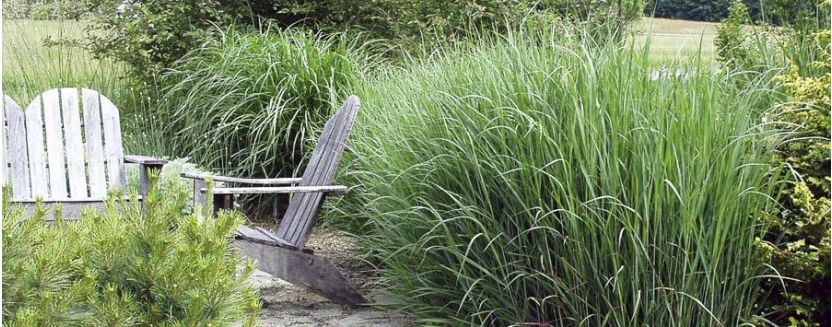
Conflicts between our expectations and what nature can provide can hardly be more obvious than when looking for a living privacy hedge:
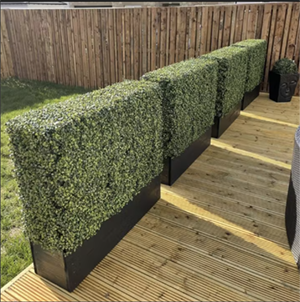
“I need a native shrub that does not exceed XX height, is evergreen, adapted to sun and shade, low maintenance and non-aggressive, is a food source pollinator insects and migrating birds, and has showy flowers preferably in summer, but I’m flexible.”
Nature is not a personal chef; it is easy to ask for extra cheese on a pizza, but plant characteristics are not made to order from menu options. Although, to be perfectly honest, it can be done and falls within the realm of plant breeders who travel the globe far and wide looking for specimens to manipulate to please gardeners’ appetites. With each requirement, our options become more limited. The above quote seems far fetched, but I have often seen that very request. If anyone has a recommendation, please let me know, because I’m stumped.
So, rather than insisting on setting the rules, how about thinking outside the box…wood? What if we deconstruct the requirements and find a combination of plants that will meet our needs rather than set off on a quest for the Holy Grail? What if we think in terms of plant communities rather than monocultures?
Our recent blog post “Building Your Plant Community” dealt with medium-height plant communities adapted to full sun. We can apply the same principles and create a living, ecologically functional, privacy screen by scaling up the plant selection.

Again, it is important to start with the grasses. Because we are not using woody plants, they will be the foundation and provide the structure for the screen. They’re not evergreen. However, the goal is to have year-round privacy, and aside from the couple of months following their cutback in spring, grasses will accomplish that.
For a tall and very dense screen, no native grass will outperform Panicum virgatum (switchgrass). Once one of the dominant grasses in the Tall Grass Prairies of North America, it has been embraced by the horticulture trade. The species is highly variable, which has led to many natural selections and named cultivars. Some selections are shorter than the species, which tends to top off at about 6’ when in seed, while others will tower at up to 8’. Leaf color may vary with selections shifting towards silvery or bluish hues, such as the aptly named Panicum ‘Heavy Metal’. Others are sought after for their fall foliage, or colorful seed heads.
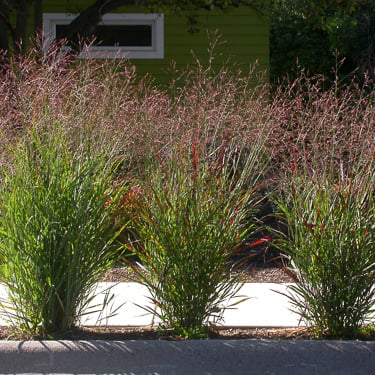
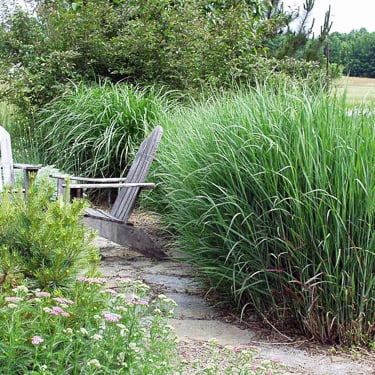
One of the tallest cultivars available is Panicum ‘Thundercloud’. Reaching heights upward of 8’ with robust stems that will remain erect throughout the season, it will create an impenetrable screen.
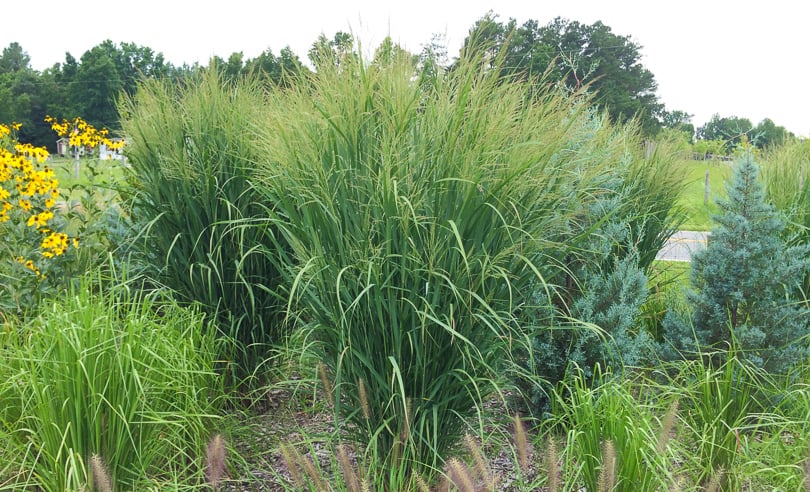
There are many other good options for lower hedges or screens that will offer some level of transparency. These are particularly useful if an integrated planting is desired where perennials are combined with the grasses rather than in front of a row of them. Some grasses to consider are:
Andropogon gerardii (big bluestem) is a warm season prairie bunchgrass with erect culms (flowering stems) that will extend several feet above the arching, long, blue-green foliage.
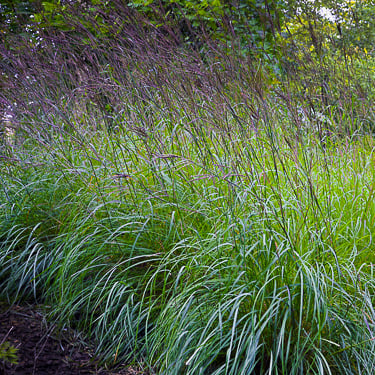
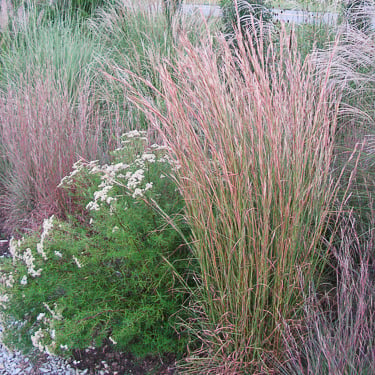
Photo courtesy of Hoffman Nursery, Inc.
Andropogon virginicus (broomsedge bluestem) is a somewhat shorter option that tops off at 4’ to 5’ when in seed. This warm-season bunchgrass is ideal to use as a matrix into which tall perennials will be integrated.
Sorghastrum nutans (Indiangrass) is a tall prairie grass that is found throughout the US east of the Rockies. With excellent ornamental features, its long arching blue-green blades and golden plume-like seed heads - that can reach a height in excess of 7' - are striking when used as an accent plant and when planted in large groups The foliage will turn deep shades of orange to purple in fall, and retain both color and erect form well into winter.
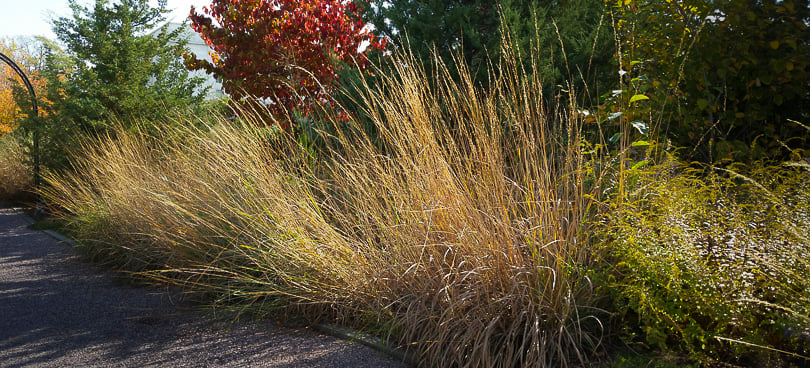
With the grasses in place, setting the foundation for the screen, there are endless possibilities for adding flowering herbaceous perennials that will contribute to the ecological value of the endeavor. If there is space available in front of the screen, it can be treated as its own separate project with more grasses of varying height interplanted with forbs (herbaceous flowering plants that are not graminoids) to build up a plant community.
Interspacing forbs into the hedge is also an option, though the benefit of increasing plant diversity might come at the expense of having a more transparent screen outside of the growing season. Working with tall grasses will require working with equally tall forbs. Lucky for us, many of these taller plants are also keystone species that will provide the highest level of ecological benefits, providing food and shelter for herbivorous insects, pollinators and birds.
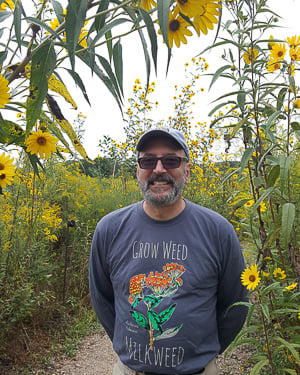
One of the tallest flowering herbaceous perennials available for a dry, sunny spot is Helianthus giganteus (giant sunflower). It is not considered a giant for the size of its flowers, which although profuse are relatively small at 3” across, but because it is a skyscraper of a forb. Within a couple of years after planting, you can expect to crane your neck to admire the blooms up to 9’ off the ground.
Staying within the Helianthus genus, Helianthus grosseserratus (sawtooth sunflower) also tops the list (pun intended). When happy, these plants can also reach a height of 9'. And, with larger leaves and flowers than H. giganteus, will create a very effective contribution to privacy.
Similar in many ways, but with even larger leaves that seem to come straight out of a land before time, is Silphium perfoliatum (cup plant). It will tolerate a spot with light levels shy of full sun, and thrives with consistent moisture.
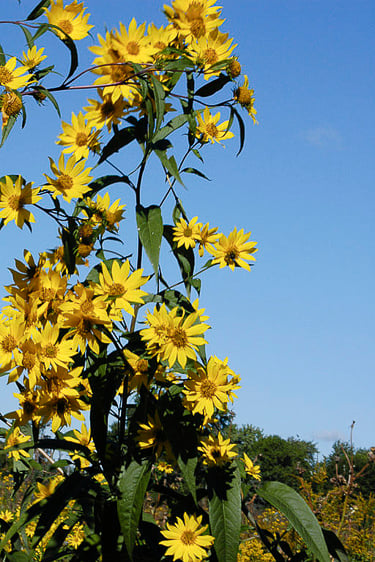
Photo: WikiMedia Commons
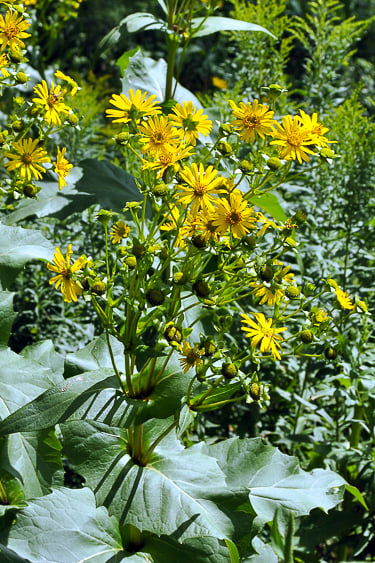
Photo: © Arron Carlson via Flickr
Another behemoth, should you have a sunny spot that does not dry out, is Eutrochium fistulosum (hollow Joe-Pye weed). “They” say it grows 5 to 7’, but I dare say “They” might be wrong. Mine reached the 13’ mark one year when it received abundant summer rainfall, and otherwise typically grows 10 to 11’. I use it as a stand-alone screen in my garden, although it doesn't offer much privacy during the off season. This Joe-Pye also pairs well with the taller switchgrasses because its dense root system will prevent it from being pushed out by the equally dense roots of the grass.
A smaller plant, but one with tremendous ecological value, is Rudbeckia triloba (browneyed Susan). Reliably growing up to 5’ tall, it can reach an equally impressive diameter, forming a mound chock-full of flowers from mid-summer through early fall. Once it starts setting seed, it might turn bright yellow, not because of new flowers but because it will attract flocks of goldfinches. Keep in mind that the species is considered to be a biennial or short-lived perennial. However, it self-seeds readily and will move around in your planting wherever it finds a bare spot.
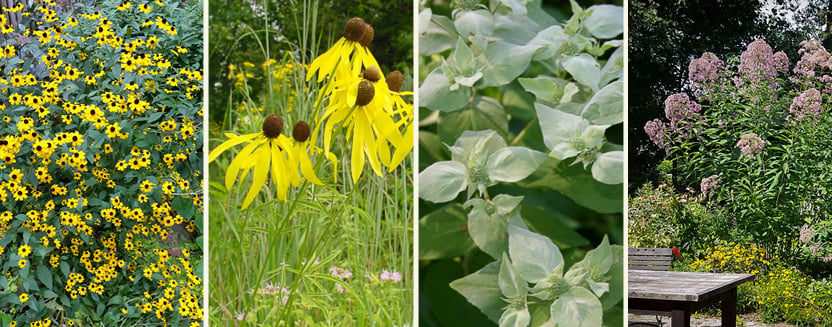
An early successional species that will establish quickly is Ratibida pinnata (pinnate prairie coneflower). It is a great choice for adding diversity while the grasses take hold. The grasses will also help prop up and keep these top-heavy plants from flopping, but they might get pushed out over time.
One species that will not get pushed out by the grasses is Pycnanthemum muticum (clustered mountainmint). It is on the short side, typically growing to 3’ although I’ve seen it reach 4 to 5’, but is on this list for a few reasons: it is not a pushover and will pair well with the grasses, the dense foliage creates an effective screen for the foreground or a confined space, and it is a pollinator magnet!
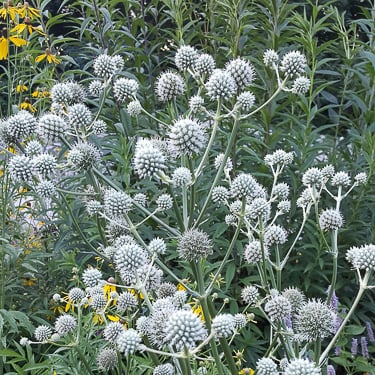
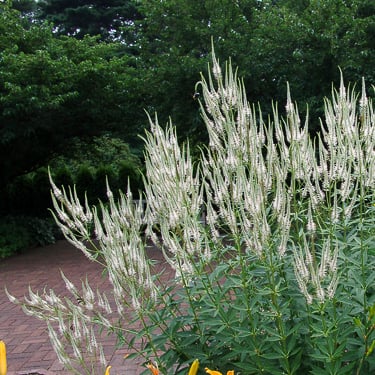
Photo: © North Creek Nurseries
I could go on and on, but must stop at some point. So, I will just mention a couple of my favorite species that can serve as vertical accents: Veronicastrum virginicum (Culver's root) is adaptable to varying degrees of sunlight, will grow into dense clumps up to 6’ tall and is topped with white, candelabra-like flower clusters. And, lastly, Eryngium yuccifolium. It is highly valuable to pollinators and birds alike, and goes by one of the coolest common names in the plant world: rattlesnake master. If nothing else, grow it so that you can throw the common name into a conversation!
All photographs are © Izel Native Plants unless otherwise annotated. Opening photo of Panicum virgatum 'Heavy Metal' ('Heavy Metal' switchgrass). © Hoffman Nursery, Inc

Claudio Vazquez co-founded Izel Plants in 2009 to fill the gap in online information about native plants that was pervasive at the time. With an initial focus on describing horticulturally available native plants, Izel Native Plants has since evolved into one of the top destinations for purchasing native plants online.

